 how-to
How do you choose a bespoke wedding florist?
Last Updated: October 25, 2026
Quick Summary
To choose bespoke wedding florist, research portfolios that match your aesthetic, shortlist 2-3 designers whose style aligns with your vision, and book consultations 6-12 months before your wedding. A bespoke florist creates custom designs specifically for you rather than offering pre-designed arrangements, collaborating closely to understand your mood, colours, venue, and personal style.
- Book your florist 6-12 months ahead; peak season (September to April) fills faster and bespoke designers take fewer weddings per month
- Review portfolios for cohesive aesthetic and recognisable point of view, then check for experience with your venue type, season, and guest count
- Ask florists about their design process, venue visits, substitution policy, and what their quote includes before committing to a consultation
- Allocate budget roughly as 40-50% installations, 20-30% personal flowers, 15-20% centrepieces, and 10-15% delivery and setup
- Compare proposals side-by-side on itemised quantities, flower lists, installation mechanics, and delivery terms rather than total price alone
Table of Contents
- Understanding bespoke wedding florist services and what sets them apart
- Building your wedding floral vision: mood board and personal style
- When to book a wedding florist and why timing matters
- Researching and shortlisting florists: portfolio review and style matching
- Questions to ask a wedding florist before your consultation
- Setting your wedding flower budget and understanding what's included
- The consultation, proposal, and booking process
- Frequently Asked Questions
Understanding bespoke wedding florist services and what sets them apart
When you choose bespoke wedding florist services, you get custom floral designs made specifically for your wedding, not from a pre-designed catalogue. Unlike a regular florist offering standard arrangements, a bespoke designer works with you to understand your vision, venue, and personal style, then builds every bouquet, centrepiece, and installation around those details.
You're paying for their creative process, not just their inventory. They'll learn what matters to you, mood, colours, flowers with meaning, and consider your venue's lighting, architecture, and season.
At My Botanic Life, every wedding is a collaboration: we ask what you want, then design specifically for you, the flowers feel personal, not generic.
Wedding planning guides from The Knot confirm that personalised floral design is one of the most memorable elements couples mention after their wedding.
Building your wedding floral vision: mood board and personal style
Collect images that make you stop scrolling, Pinterest, Instagram, wedding blogs, magazines. Look for colours, textures, mood, and arrangement style; after 30-50 images, patterns will emerge.
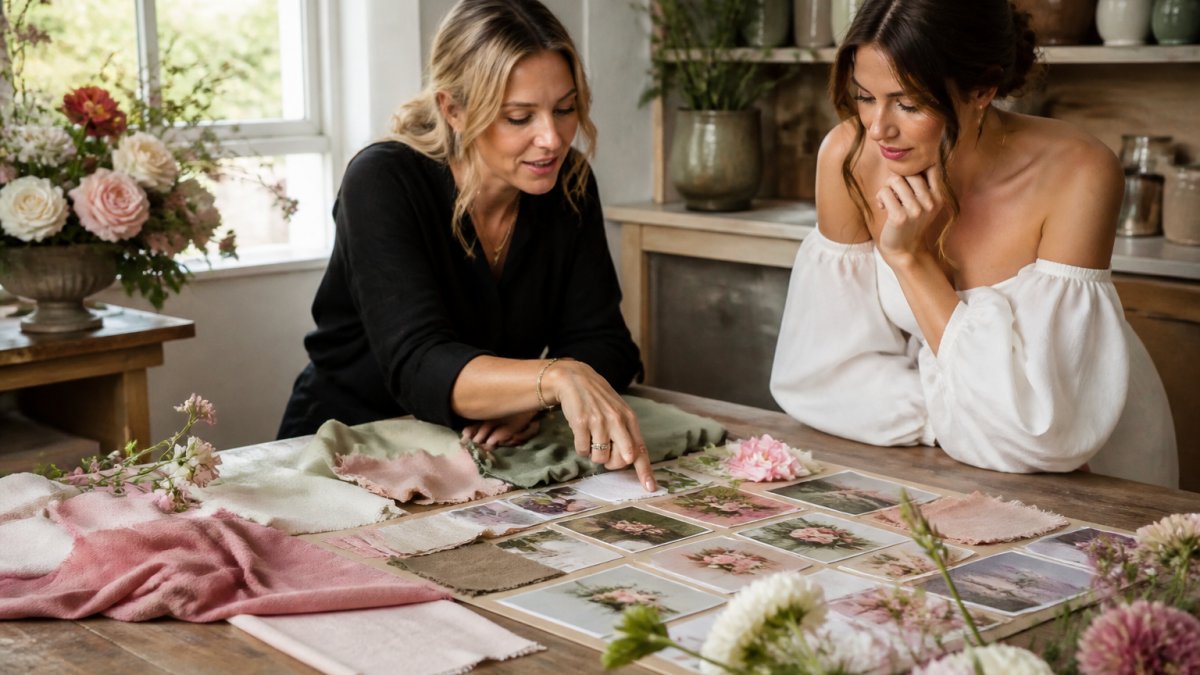
Next, identify what you're drawn to:
- Colour palette: Are you seeing soft pastels or rich jewel tones? Monochromatic or mixed? Seasonal or year-round?
- Style: Romantic and loose? Structured and geometric? Wild and garden-like? Minimalist?
- Texture: Do you prefer full, abundant arrangements or spare, airy ones?
This is your mood board, a visual conversation starter with your florist.
When you learn how to communicate your wedding floral vision, you'll refine these instincts into clear language your florist can work with.
When to book a wedding florist and why timing matters
Book your florist 6-12 months before your wedding, giving them time to understand your vision, source seasonal flowers, and plan logistics.
For destination weddings or high-season dates, aim for the earlier end, bespoke designers take fewer weddings per month.
Booking early also means your florist can visit your venue, you have time to explore design options, and seasonal availability is easier to plan around.
Timing your florist booking affects design quality, seasonal availability, and logistics.
| Booking window | Best for | Key consideration |
|---|---|---|
| 6-12 months before | Standard timeline | Allows venue visit, design exploration, seasonal planning |
| Earlier end of 6-12 months | Peak season (Sept-April) | Peak season fills faster; bespoke designers take fewer weddings |
| Within 3 months | Rush bookings | Some florists accommodate; affects their process |
| Destination weddings or high-season dates | Early booking | Aim for earlier end of 6-12 month window |
Researching and shortlisting florists: portfolio review and style matching
Start with florists whose work you actually like. Review portfolios not to copy them, but to see if their aesthetic aligns with yours.
When you review a portfolio, ask yourself:
- Do the arrangements feel cohesive or scattered?
- What colours, textures, and styles appear most often?
- Does the work feel personal or templated?
A strong portfolio shows range but also a recognisable point of view. You should be able to imagine your wedding in their style.
Next, check for evidence of experience with your wedding type:
- Destination weddings (if that's your plan)
- Your venue type (garden, warehouse, ballroom, outdoor)
- Your season and flower preferences
Read testimonials for specifics. "Amazing florist" tells you nothing; "Nicole understood exactly what I meant by 'romantic but not fussy'" tells you they listen.
Shortlist 2-3 florists whose portfolios genuinely appeal to you when you choose bespoke wedding florist options. You're about to spend months collaborating with this person, so style fit matters more than price at this stage.
Questions to ask a wedding florist before your consultation
Before you book a consultation, clarify the basics. A good florist will answer these quickly:
- What's your design process, and how much input do I have?
- Do you visit the venue, or work remotely?
- What happens if my preferred flowers aren't available on my date?
These questions filter out mismatches before you invest time. If a florist seems defensive or vague about process, that's a signal.
During your actual consultation, dig deeper into their creative approach:
- How do you translate mood boards into actual designs?
- What questions do you ask to understand a couple's vision?
- How do you adapt designs for venue constraints?
A bespoke florist should ask you as many questions as you ask them. If they're mostly talking about what they do rather than learning what you want, that's a red flag.
Setting your wedding flower budget and understanding what's included
Pricing for bespoke floral design depends on guest count, flower choices, venue complexity, and delivery distance. Ask for a quote based on your specific wedding, but go in with a framework so you can read it critically.
A practical allocation framework
Most couples find it useful to think about the floral budget in tiers rather than one lump sum, allocating roughly:
- 40-50% to reception and ceremony installations, arches, hanging pieces, aisle meadows, tablescapes. These are the labour- and material-heavy items.
- 20-30% to personal flowers, bouquets, buttonholes, corsages, flower crowns. Small in volume, high in perceived value.
- 15-20% to centrepieces and table florals, the per-table cost multiplies quickly with guest count.
These are starting points, not rules, a marquee wedding with a long aisle and 12 tables skews toward installations and centrepieces; a small elopement toward personal flowers and one focal arrangement.
What actually drives the price
When a quote feels high or low, these are the levers behind it:
- Flower variety and grade. Garden roses, peonies, and specialty orchids cost multiples of carnations, chrysanthemums, or standard roses. A single peony stem in peak season can cost several times a standard rose; out of season, the gap widens further.
- Seasonality. Locally grown, in-season blooms are typically cheaper and fresher than imported stems. A design built around what is abundant in your month will almost always quote lower than one demanding out-of-season imports.
- Labour and scale. Installation work, arches, hanging mechanics, large urns, is labour-intensive and often requires a crew, a van, and a site visit. A 20-table reception is not simply 20 times a single centrepiece; it is a logistics exercise.
Reading a quote like-for-like
Two quotes for the same wedding can look similar in total and be wildly different in scope. Compare these line items side by side before comparing totals:
- Quantities per item, number of bouquets, buttonholes, centrepieces, and installations, with sizes noted.
- Flower list per item, the specific varieties and approximate stem counts, not just colour descriptions.
- Installation and setup, who builds, who supplies mechanics (arches, stands, vessels), and whether setup is included or extra.
If the quote is above budget
A good florist will work with you rather than simply discount. Practical levers include:
- Reducing the number of large installations and concentrating impact in one or two focal areas.
- Repurposing ceremony flowers at the reception (an arch moved behind the head table, aisle flowers becoming table runners).
- Swapping out-of-season or premium varieties for in-season equivalents that read similarly.
Ask what drives the cost and which changes would move the number most. A florist who explains pricing clearly will manage your budget transparently.
The consultation, proposal, and booking process
A proper consultation takes 1-2 hours, covering your vision, venue, season, and preferences; the florist takes notes, asks questions, and often sketches ideas. But the steps around it are where most couples lose time or money. Learn what to expect at each stage of the bespoke floral design process.
A realistic booking timeline
A common pattern for a bespoke wedding looks like this:
- 12-9 months out: Research florists, review portfolios, shortlist 2-3, and book initial consultations. Peak-season dates (September to April) close earliest.
- 9-6 months out: Hold consultations, receive proposals, compare like-for-like, and confirm your florist. Sign the contract and pay the deposit.
- 6-3 months out: Refine the design, confirm flower lists and quantities, and lock in venue access details with the venue or planner.
Comparing proposals on a like-for-like basis
When proposals arrive, resist comparing totals. Compare scope, put the proposals side by side and check:
- Itemised quantities and sizes, bouquets, buttonholes, centrepieces, installations, with dimensions where relevant.
- Flower lists per item, varieties and approximate stem counts, not just colour mood words.
- Installation and mechanics, who supplies arches, stands, vessels, and candleholders, and who builds and removes them.
Venue logistics and installation requirements
This is where bespoke floral design becomes a production exercise, and where quotes diverge most. Before approving a proposal, confirm with the venue and florist:
- Access times and windows, when can the florist load in, and by when must setup be complete? Many venues have tight morning windows before other events.
- Access constraints, stairs, lifts, loading docks, door widths, and whether large installations must be built on site rather than brought in assembled.
- Power and water, whether the venue provides water access for conditioning and power for any lit or mechanical elements.
A bespoke florist will usually want a site visit or detailed venue brief. If working remotely, ask how they account for access and installation constraints in their quote.
Contract, payment, and change terms
Before you sign, read the contract for these terms, and ask for anything unclear to be confirmed in writing:
- Deposit and payment milestones, the percentage due on signing (commonly in the 25-50% range) and the dates for interim and final payments.
- Minimum spend, some bespoke florists set a minimum for wedding work, particularly on peak dates.
- Cancellation and postponement policy, what is refundable, what is retained, and how date changes are handled.
Substitutions and contingency planning
No bespoke florist can guarantee every stem on the day. What separates a good one is how they plan for it:
- Seasonal sourcing windows, a florist who knows your month will build the design around what is reliably available rather than gambling on a single variety.
- Substitution hierarchy, ask what they would use if your must-have flower is unavailable, and whether you will be consulted or notified.
- Heat and weather planning, for summer weddings, ask how they protect delicate blooms during setup and whether they recommend a hydration plan or a shaded installation.
From approval to your wedding day, stay in touch with your florist. Confirm details 4-6 weeks before, and tell them early if your vision or guest count has shifted, they need time to adjust quantities or sourcing. The week before, confirm delivery time, venue access, and any last-minute details. A bespoke florist will check in because they care about how the day unfolds.
Frequently Asked Questions
What is the difference between a bespoke wedding florist and a regular florist?
A bespoke wedding florist designs custom arrangements tailored specifically to your vision, venue, and personal style. They work collaboratively with you from concept to installation, creating one-of-a-kind floral designs. A regular florist typically offers standard arrangements and may have less involvement in the overall design direction. Bespoke services prioritise understanding your story and creating florals that reflect your unique celebration.
How far in advance should I book a wedding florist for my wedding?
Most bespoke florists recommend booking 6-12 months ahead, especially for peak wedding seasons (September to April). Booking early secures your preferred florist, allows time for detailed consultations, and ensures access to seasonal blooms. If you're planning a destination wedding or have a specific vision requiring custom sourcing, earlier booking gives your florist time to source sustainably and plan logistics thoroughly.
What should I include in my wedding flower mood board to help my florist understand my vision?
Gather inspiration images showing colour palettes, flower types, arrangement styles, and overall aesthetic you're drawn to. Include photos of venues, your dress, bridesmaids' attire, and any specific themes. Add texture samples, fabric swatches, and notes on emotions you want the florals to evoke. Share this mood board during your initial consultation so your florist can see your personal style clearly and avoid misunderstandings about what 'romantic' or 'modern' means to you.
How much should I budget for bespoke wedding flowers?
Your wedding flower budget depends on guest count, number of arrangements needed (bridal bouquet, bridesmaid bouquets, ceremony flowers, reception centrepieces, installation), seasonal bloom availability, and venue size. During your consultation, discuss what's included in quotes: delivery, setup, labour, and any substitutions. Ask your florist to break down costs by element so you understand where your budget is allocated and can make informed decisions about priorities.
Choosing a bespoke wedding florist is one of the most personal decisions you'll make for your wedding. It's not just about flowers, it's about working with someone who understands what matters to you and brings your vision to life. Explore our portfolio to see how we've worked with couples to create meaningful floral designs, or get in touch to start your consultation and begin the design process.